Current Events in Standards
August 2015
Standard Update
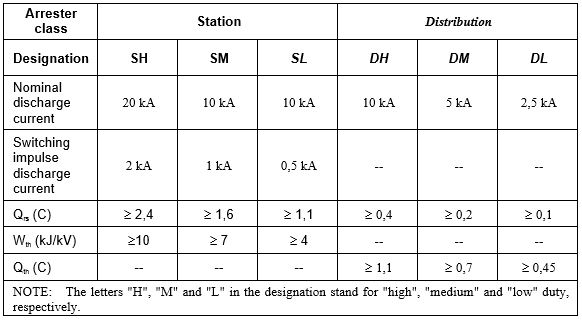
As shown in the table below, Station Class arresters will have a Qrs and Wth rating.
Distribution arresters will have a Qrs and Qth rating.
IEC MT4 and MT10 Fall Meeting attended
IEEE SPDC Fall Meeting held in Clearwater, Florida
Energy Handling
Surge Withstand Capability
Thermal Withstand Capability
Test Rationales
Start Temperature Determination
The IEC has published a new edition of 60099-4. An overview of the additions and deletions in this document are
covered in detail in ArresterFacts 007 Understanding New IEC Mechanical Requirements.
Last month the IEEE standards department published C62.11a, an amendment to C62.11. This new amendment now specifies a
short circuit test for all arresters. It has been years in the making. What makes this amendment so unique is that it
is virtually identical to the test procedure published in IEC 60099-4 in 2006. This is a first for arrester standards
harmonization. Though it will be many years before the both standards are virtually the same, this is a first step.
This CDV is a substantial change over previous mechanical considerations and needs review by all stakeholders in arresters
applied in the IEC markets.
Maintenance Team 10 of TC37 Met on March 25th and 26th. The new convenor Bengt Johnnerfelt (ABB) is leading the effort to
have a new edition available for publication in 2010. The significantly enhanced edition will include new material
that covers the application of gapped arresters both internal and external. This application guide covers arresters
tested under 60099-4, 60099-6, and the upcoming 60099-8. The first CD for this edition is planned distribution to the
National Committees in June of 2008.
The spring meeting of the IEEE Surge Protective Devices Committee will be held May 12-15 in Clearwater Florida. The meeting
specifics can be found here. The daily schedule will be published soon.
37/346/CD, which is CD2 of this document, was circulated to the national committees on Feb. 29, 2008.
The closing date is May 30, but all National committees are being asked to submit comments by May 16th.
Working Group Chair John McDaniel (National Grid) has distributed a the first draft of the next edition of this standard
for comments. He asks that they are returned to him as soon as possible. I am a member of this working group so if anyone
would like to discuss this with me, let me know via email at
jwoodworth@arresterworks.com
37/345/CDV Mechanical Considerations for Arresters
As of this past May, the IEC and IEEE High Voltage Surge Arrester Committees have
initiated a Harmonization Task force. We will be meeting 2 times per year for the
next few years with the goal of harmonizing C62.11 and IEC 60099-4. At the present
time there are several sections that were written with harmonization in mind and it
has worked quite well. There are about 5 or more sections in the design tests that
can be unified and harmonized. Our first tasks are to identify these sections and
start the process of making them as similar as possible if not identical. More info
in early November on how it is going.
December 2014
New IEC Arrester Standard Published This Year
60099-4 Ed. 3.0 - 2014: Surge arresters - Part 4:
Metal-oxide surge arresters without gaps for a.c. systems
A new concept of arrester classification and energy withstand testing is introduced: the line discharge
classification is replaced by a classification based on repetitive charge transfer rating Qrs, thermal
energy rating Wth and thermal charge transfer rating Qth, respectively. The new concept clearly differentiates
between impulse and thermal energy handling capability, which is reflected in the test procedures and minimum pass criteria.
The Definitions of these ratings are as follows:
The newest version of the publication can be purchased at the IEC Web Store.
October 2014
IEC MT4 and MT10 Fall Meeting attended
by delegates from 7 Countries
by delegates from 7 Countries
This year's fall IEC MT4 and MT10 meetings were held in Niagara Falls Canada.
Eighteen maintenance team members travelled from around the world to attend the meetings.
The focus of the meets were on the next editions of IEC 60099-4, 60099-5, 60099-6 and 60099-8. All standards
will be published in the next 3 years. A Technical Report that will likely have the Designation 60099-10 is also in the
works and will contain all the rationale of required tests. This will be a first for the IEC and should add significant
value to our work.
A special thanks to this years sponsors:
NEMA
Eaton's Cooper Power Systems
Hubble Power Systems
In 2012 the last edition of IEEE C62.11 was published. One of the main objective of the meetings in Clearwater
was to work on the next edition. The new release will include new sections related to transmission line arresters
as well as streamlined sections related to all other arresters. Target publication is 2018
January 2012
Hinrichsen Named Chairman of IEC TC 37 Professor Volker Hinrichsen has been elected as the Chairman of TC37 the Arrester Technical Committee of the IEC.
Prof Hinrichsen replaces Michele De Nigris who has fulfilled that function since 1990.
Prof. Hinrichsen started participating
in IEC standards in 1992 and has been
co-convenor of IEC TC37 MT4 since 2002 where he has repeatedly demonstrated excellent leadership.
Professor Volker Hinrichsen has been elected as the Chairman of TC37 the Arrester Technical Committee of the IEC.
Prof Hinrichsen replaces Michele De Nigris who has fulfilled that function since 1990.
Prof. Hinrichsen started participating
in IEC standards in 1992 and has been
co-convenor of IEC TC37 MT4 since 2002 where he has repeatedly demonstrated excellent leadership.
After graduating from TU Berlin
in 1982 he worked at Siemens Berlin in the
Arrester Division and by 2001 he was Director of Research and Development.
In 2001 he was named Full Professor of Electrical Engineering at Darmstadt TU in charge of the
High Voltage Lab.
For the past 10 years he has lead fundamental research on many products, including Energy Handling tests of MOV disks that
have lead to the latest changes in both IEC and IEEE Energy Handling tests.
Fast Take On
Changes Coming in IEC 60099-4 and IEEE C62.11 in 2012
After a great deal of work for the past 4 or so years, both IEC and IEEE standards groups are close to a set
realistic tests that can be used to assess the energy handling capability of surge arresters. Up until this set
of tests, there have been no tests in the standards that could be used to consistently assess the energy
handling capability of arresters nor was there any way to compare one arrester with another. These tests resolve
both of these problems. To accomplish this act, energy handling needed to be divided into two parts.
The first test evaluates the ability of the arrester to withstand the stresses involved in a high energy surge event.
In the real world, lightning as well as many surges are actually a close series of surges. This test subjects
the arrester to a series of 2-4 surges that stress the current carrying capacity of the arrester. The energy of
the surge, or the charge transferred during the surge are measured. The 90% of highest surge that the sample withstands
without damage becomes the surge withstand rating of the arrester. For this test, it was determined that an
alternate means of energy handling rating was necessary because kJ/kV is not always the best way to asses this
characteristic. A charge transfer rating has been selected as an alternate means of quantifying this characteristic.
The unit measure for this rating is coulomb.
This second energy handling rating measures the maximum energy for low current surge events that may stress the arresters
for many cycles. During these events, the arrester temperature rises and can reach a level that leaves it so hot after
the event that with 50 or 60 hz power still applied, it cannot cool down and recover. This test measures the maximum
quantity of energy that an arrester can dissipate and still recover after the event. This energy rating is best
quantified in kilo-joules.
In the next edition of IEEE C62.11, an annex will be added that offers the rationale for all tests in the standard
one by one. This section will give future generations of standards writers an idea as to why the tests were developed
and what problems they helped solve. It will also give the novice in testing a better understanding of what may be
difficult to understand in the test specification. In all, the entire working group has offered input on this annex and
all are very pleased with the value it added to the standard.
For many years, in both IEEE and IEC test standards, several of the required tests also required that the test be
started at 60C. (ODC and TOV for example) For higher rated multi unit arresters taller than 1 meter, this has not
been realistic. Coming in the next edition of 60099-4 will be a complex, but realistic means of determining the
temperature at which the Thermal Energy Tests and TOV tests will be started.
If you have any questions or comments, please email me at
Jonathan.Woodworth@ArresterWorks.com
Posted December 12, 2010
IEC 60099-4-am2 Ed. 2.0 Bilingual
Feb 26, 2009
This new edition covers new mechanical test requirements for polymer and porcelain housed arresters.
The new edition can be purchased at here
C62.11a Published
Overview of the amendment can be found here.
37/345/CDV
March 28, 2008
Mechanical Considerations for Arresters
IEC 60099-5 1998
March 26, 2008
Surge Arresters: Part 5 Selection and application recommendations
IEEE SPD Spring Meeting Schedule Announced
March 11, 2008
IEC 60099-8:
Feb 29, 2008
Surge arresters - Part 8: Metal-oxide surge arresters with external series gap (EGLA) for overhead transmission and
distribution lines of a.c. systems above 1 kV
IEEE 1410 D1
Jan 4, 2008
Draft Guide for Improving the Lightning Performance of Electric Power Overhead Distribution Lines
IEC 60099-4 Ed 2.1 10-2006
Dec 14, 2007
Surge arresters - Part 4: Metal-oxide surge arresters without gaps for a.c. systems
Maintenance Team 4 of IEC Technical Committee 37 has just distributed its first CDV regarding new mechanical considerations
for surge arresters relating to 60099-4. This is a substantial change in the standard with regard to mechanical requirements
of arresters of these types. The MT Convenor Volker Hinrichsen has requested that the comments and votes be received by
May 1st so that the May 25th meeting can be used to finalize this change to the standard and issue the FDIS.